
When an institutional investor needed a new servicing path for a non-prime auto portfolio, the obvious solution was to transfer the portfolio to another servicer.
Concord approached the transition differently: change who was responsible for the portfolio without unnecessarily changing the operation behind it. Rather than replace ACC's servicing operation, Concord proposed lifting out its people, platform, and infrastructure and integrating them into Concord.
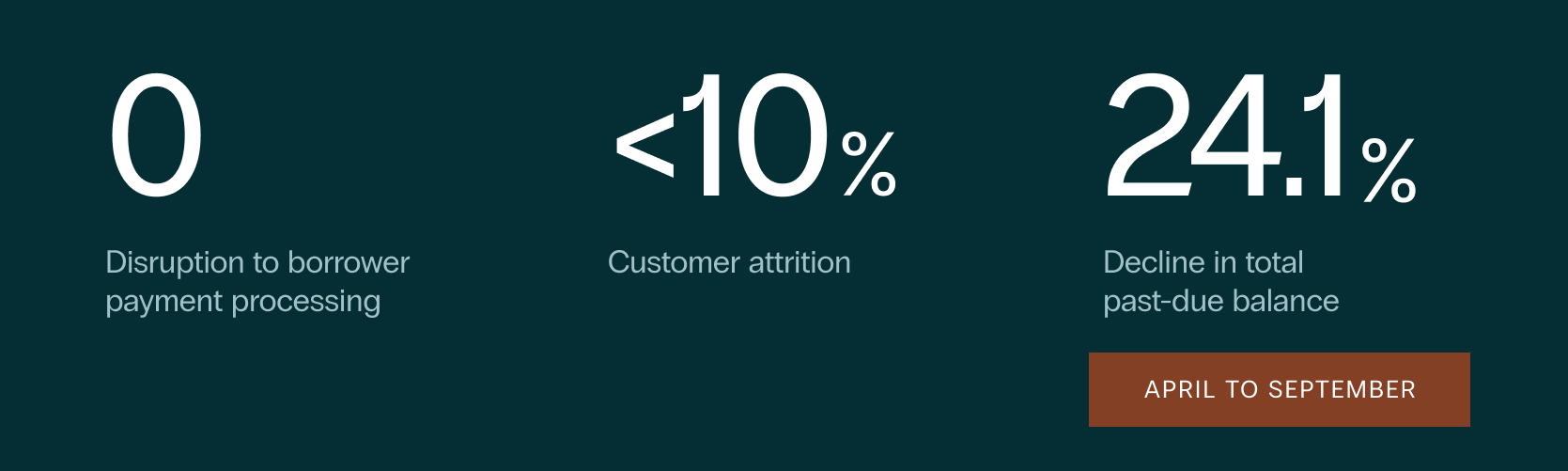
The approach preserved operational continuity while allowing Concord to take on and operate a live non-prime auto portfolio as its primary servicer. Borrower payment processing continued without disruption, and customer attrition remained below the 10% risk investors had anticipated.
The result was continuity for borrowers and investors, while Concord took on a live non-prime auto servicing operation without rebuilding it from the ground up.
The portfolio represented roughly $120 million in non-prime auto receivables and approximately 12,000 customers. ACC was already servicing the accounts, with an operating team, established workflows, servicing technology, payment infrastructure, and institutional knowledge of the portfolio.
The servicer needed to change, but the portfolio was already operating within an established servicing environment. The question was how to change the servicer without creating unnecessary disruption for the borrowers, the operation, or the investor.
“A servicing transfer looks like a technology project on paper, but operationally, it’s a borrower and performance event. You can move every data field perfectly and still disrupt payment behavior, collections, recoveries, and ultimately portfolio economics if you lose the operating infrastructure surrounding that data.”
— Andrew Coffey, SVP, Enterprise Sales & Partnerships, Concord
For the investor, the concern was customer attrition. Roughly 10% was the anticipated risk associated with the change.
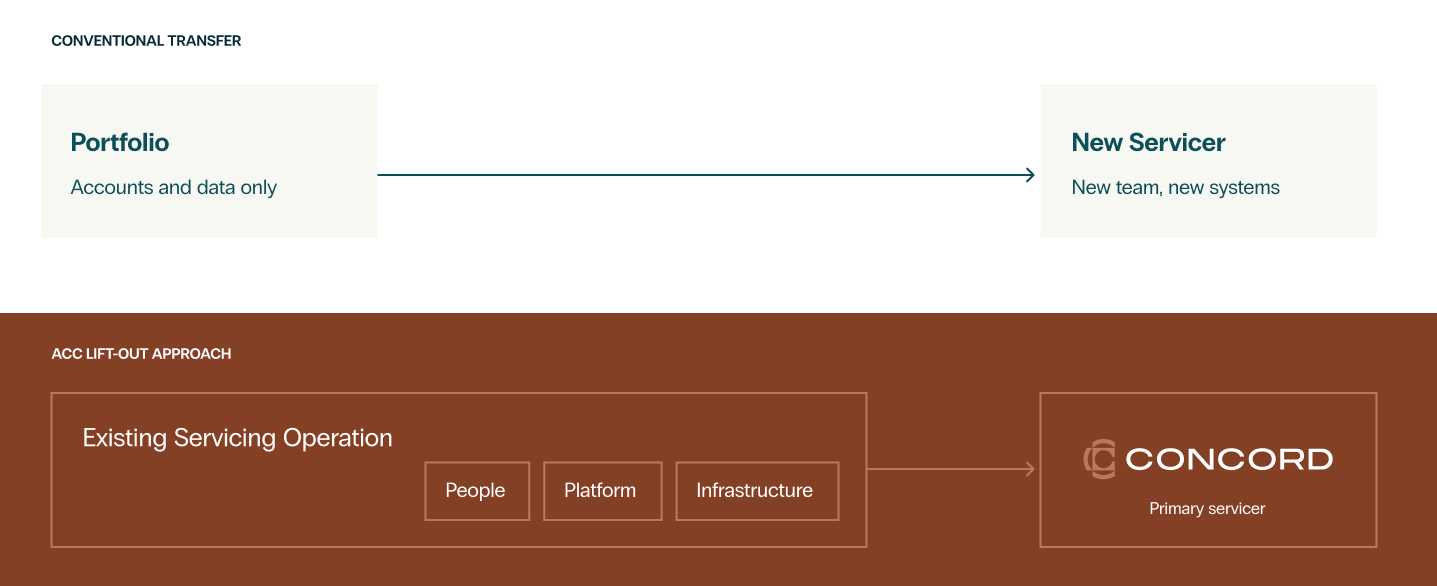
Concord proposed preserving the operation already servicing the portfolio and bringing it into Concord.
ACC had an experienced team that understood the borrowers, the portfolio, and the day-to-day work required to service it. Rather than replace that institutional knowledge, Concord would retain the core operating team and integrate them into its consumer servicing organization.
ACC's ownership also wanted to protect long-standing employees. Concord saw value in retaining that experience, so the two organizations jointly presented the lift-out approach to the institutional investor.
Preserving the existing operation still required Concord to integrate it into its own organization. Concord established banking relationships, transitioned vendor contracts, redirected deposits, and established critical third-party relationships. It also brought the operation into Concord's broader operating environment without disrupting the systems and processes already supporting the portfolio.
That allowed Concord to preserve what was working while evaluating where the operation could improve, rather than rebuilding the servicing operation from the ground up.
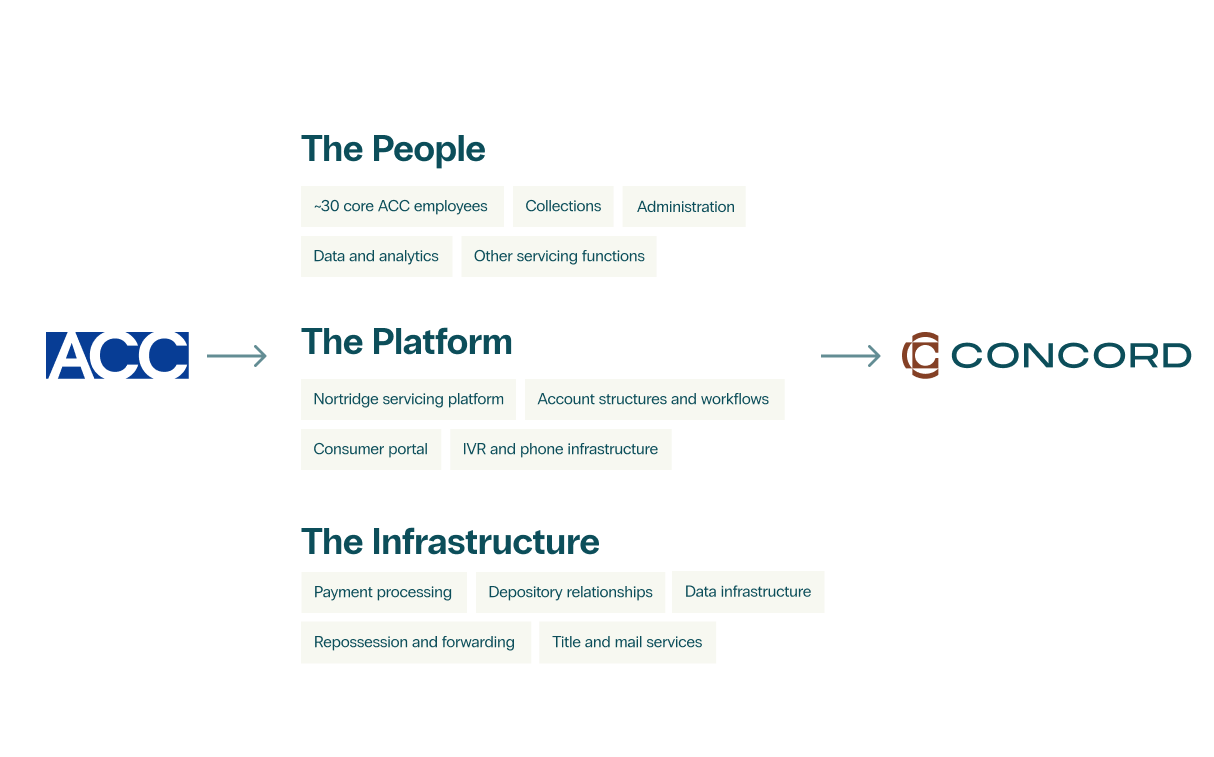
The lift-out depended on preserving more than a team. Concord had to carry forward the systems, relationships, and operating infrastructure that supported the portfolio, then connect those pieces to Concord's organization.
Approximately 30 core ACC employees joined Concord, spanning collections, administration, data and analytics, and other servicing functions.
They already understood the portfolio's borrowers, workflows, servicing practices, and operating history. Bringing those employees into Concord kept that knowledge with the operation while the servicing relationship changed.
The existing servicing environment stayed in place rather than introducing a wholesale system migration alongside the servicing change. Concord contracted directly with Nortridge to maintain access to the existing servicing platform, keeping established account structures and workflows in place along with familiar borrower-facing systems such as the consumer portal, IVR, and phone infrastructure.
This avoided moving the portfolio to an entirely new servicing system at the same time the servicer changed.
Payment processing, depository relationships, repossession and forwarding networks, title and mail services, and data infrastructure all had to remain connected as the operation moved into Concord.
Some relationships could be maintained, while others had to transition into direct Concord contracts. Existing vendor issues also surfaced during the handoff, including unpaid ACC invoices that complicated relationships with some repossession forwarders.
The lift-out had to preserve continuity after the transition. Borrowers needed to keep paying, customers needed to stay with the portfolio, and Concord needed to take responsibility for the accounts without the disruption investors had anticipated.
Borrower payment processing continued without disruption, and customer attrition remained below the roughly 10% risk investors had anticipated. From April through September 2026, total past-due balances declined 24.1%.
Concord also inherited the portfolio's recovery practices and the challenges that came with them. Some delinquent accounts had been moving in and out of the repossession process after making individual payments without actually curing. Other recovery decisions depended on vehicle condition, repair costs, auction values, and the cost of pursuing recovery.
Concord tightened recovery practices, particularly for accounts 120 or more days delinquent, evaluating recovery decisions against the economics of each account rather than simply carrying forward the existing approach.
By September 2026, Concord was managing more than 10,500 contracts representing approximately $84.6 million in net investment, including the portfolio's remaining delinquency and recovery activity.
Concord entered the ACC opportunity with significant experience supporting automotive portfolios, including backup servicing. What ACC added was a different test: could Concord take on a live non-prime auto portfolio as primary servicer while preserving the operation that already supported it?
“The fact is, we’re doing it. We have a portfolio. We’re successfully managing it.”
— Shaun O’Neill, Managing Director, Portfolio Administration, Concord
The lift-out demonstrated that capability in practice. Concord integrated the existing team, servicing environment, payment infrastructure, and vendor relationships, then took responsibility for the portfolio's ongoing performance and recovery activity.
The experience gave Concord a demonstrated primary servicing track record in non-prime automotive finance, with an approach to integrating an existing servicing operation while maintaining continuity for the portfolio.
A servicing transition can affect more than who is responsible for the portfolio. It can change the people managing it, the systems supporting it, and the experience borrowers have along the way.
The ACC lift-out shows another path. By preserving the operation behind the portfolio and integrating it into Concord, the transition maintained continuity while giving the investor a servicing organization equipped to manage the portfolio through its remaining life.
For specialty finance companies, investors, and capital providers considering a servicing change, the question is how to make that change while preserving what already works and positioning the portfolio for what comes next.
{{cms-button-ap}}
4343 N. Scottsdale Rd., Ste. 270
Scottsdale, AZ 85251
NMLS ID 365917

