
Growth in equipment finance takes more than finding customers who need financing. Companies evaluate new markets, develop financing programs, and build origination channels to grow their portfolios.
But there's a question worth giving just as much attention:
Is the business equipped to support what it's bringing onto its books?
Servicing often enters the conversation after decisions about products, growth, and operations have already been made. Yet, the people managing portfolios and working directly with customers see what those decisions mean once a deal is funded. Their perspective can help companies understand what's required to support the business they're building.
Equipment finance agreements can look very different depending on the equipment being financed and the customer's circumstances. We're seeing originators and lessors take a more tailored approach to structuring deals, with funding and payment schedules built around how and when equipment will be used.
Take a manufacturer ordering customized equipment for $150,000. Rather than advance the full amount upfront, the originator might release $50,000 at the outset, another $50,000 six months later, and the final $50,000 at a later stage of production. The customer may make smaller payments while the equipment is being built, then move to larger payments once it arrives and starts generating revenue.
On the other hand, agricultural financing can follow a different rhythm. Historically, some agreements called for one annual payment tied to the harvest cycle. Each arrangement creates its own requirements for administering the agreement.
These structures take careful coordination once they're on the books. A servicing team familiar with different funding and repayment arrangements can help originators understand what a proposed deal will require operationally and whether their current operation can support it.
We often hear servicing described as sending invoices and collecting payments. Those activities are part of the job, but they leave out much of what goes into managing an equipment finance portfolio.
Depending on the agreement, servicing can involve tax and insurance administration, borrower communications, and delinquency management. More involved situations may also call for specialized collections and legal resources.
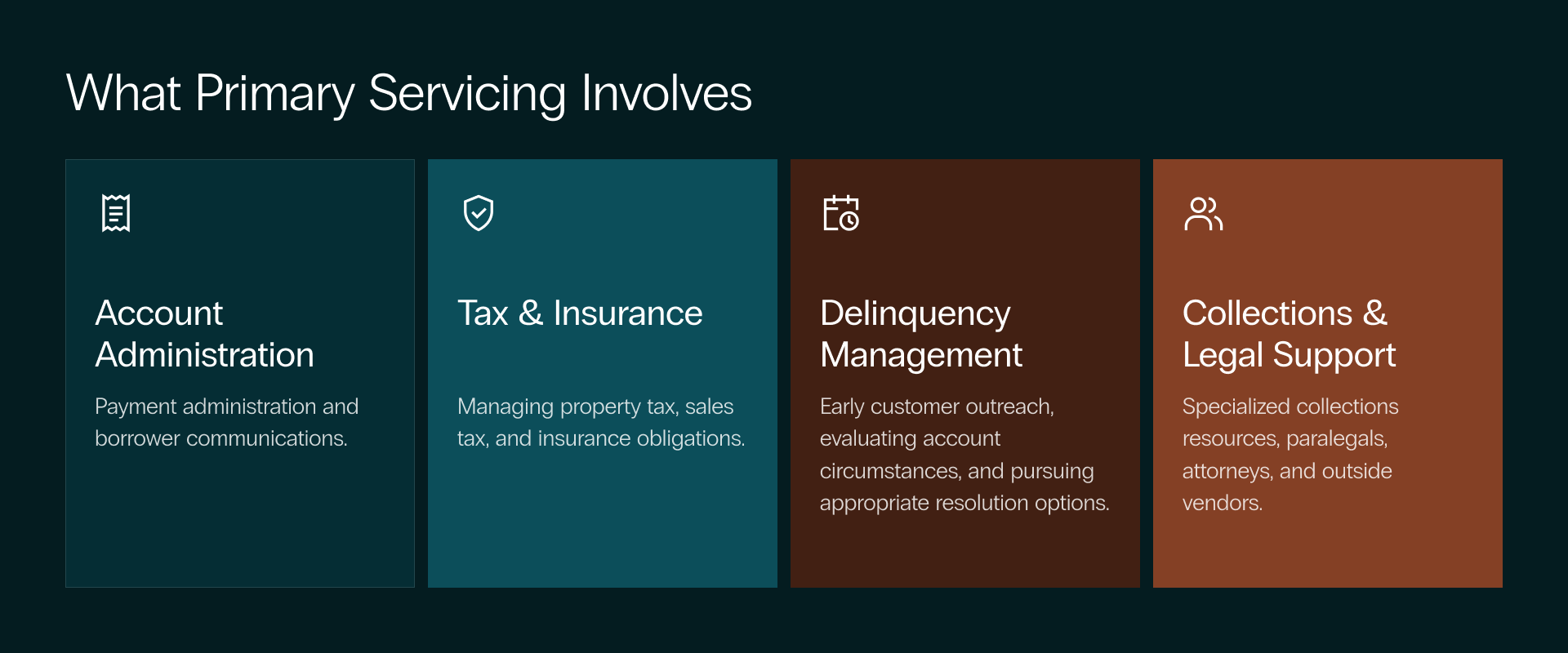
Each area requires people who know the work, along with the processes and outside relationships to get it done. Originators spend their time finding opportunities, structuring transactions, and securing financing. Managing the agreements after funding calls for a different set of skills and resources.
Customers experience the financing company through the people they interact with and the processes supporting their agreements. Once a deal is funded, the servicing team becomes a regular point of contact, handling the questions, requests, and issues that come up over the life of the agreement.
When a company uses a first-party servicing model, customers interact with the servicing team as an extension of the financing company's own operation. The servicer needs to understand how the client works with its customers, what it expects from those relationships, and how it wants different situations handled.
“We're an extension of your servicing department. We are you.”
— Jenny Wood, SVP, Head of Commercial Client Experience, Concord
Clients also need to know how those conversations are going. Through our portals, they can review customer communications, including copies of emails and call recordings upon request.
That responsibility becomes particularly clear when a customer falls behind on payments. A missed payment can raise questions that go well beyond how much is owed or how long an account has been past due. The servicing team may need to look at the customer's circumstances, the value of the equipment, the customer's credit, and any available guarantor support before deciding how to proceed.
Those situations require judgment and a clear understanding of the client's interests. More involved cases may call for specialized collections resources or legal support, with the servicing operation coordinating the work.
Staffing is often the first cost equipment finance companies consider when looking at an in-house servicing operation. But people are only part of the equation. The business also needs the systems, specialized expertise, and outside providers to support the work.
Property tax administration, insurance tracking, and sales tax obligations all require attention. Servicing operations also rely on outside providers for specialized services. At Concord, we work with approximately 15 vendors across our servicing operations, each with its own services and costs to manage.
The systems behind the operation need to support account administration, organize information, and coordinate work across customers and outside providers. The team also needs people who understand the agreements and the responsibilities involved. SOC audits and other oversight add to the investment.
Those demands can change with the market. During periods of economic uncertainty or increased account activity, an in-house operation may need additional staff, systems, or outside support. Companies must account for those costs even when they can't predict exactly when that additional capacity will be needed.
Outsourced servicing gives equipment finance companies access to an established operation, including the people, systems, vendor relationships, and specialized resources needed to manage a portfolio. Companies can draw on those capabilities without having to build and maintain the entire operation themselves.
Servicing teams hear directly from customers and work with account information throughout the life of an agreement. Those conversations and account details can reveal new financing opportunities and give companies a better view of portfolio activity.
At Concord, we conduct post-call check-ins after customer service calls to ask whether customers need additional equipment. When someone expresses interest, we pass that opportunity along to the client, who can decide how to pursue it.
Account notes, payment histories, contract details, and customer communications also give financing companies useful context for managing their portfolios. Client portals and self-service reporting make that information available without requiring clients to wait for scheduled reports or request individual updates. They can review account activity and pull the information they need to evaluate individual transactions.
A servicing partner can bring that same customer perspective into conversations about new financing programs. Its team hears directly from customers and sees how agreements work in practice. That experience can help a financing company anticipate customer questions and understand how a new product might be received.
“Because we're talking to your customers every day, we can help you understand how a new product might be received.”
— Jenny Wood, SVP, Head of Commercial Client Experience, Concord
Bringing servicing into those discussions early gives companies another perspective before a new program reaches the portfolio.
Before launching a new financing program, entering a market, or planning for portfolio growth, equipment finance companies should think through what those decisions will require of their servicing operation.
Do the agreements call for specialized administration? Can the business maintain the customer experience it wants? Does it have the people, systems, and outside resources to manage the work as the portfolio changes?
The answers can help companies determine whether their current operation can support those plans or whether a servicing partner could provide capabilities they don't have internally.
“I think there's a lot more value in treating your servicing company as a partner than simply viewing it as a vendor.”
— Jenny Wood, SVP, Head of Commercial Client Experience, Concord
Concord's first-party servicing model operates as an extension of each client's servicing department. Our teams manage the day-to-day responsibilities while representing the client's approach to its customer relationships. If you're evaluating your current operation or planning for growth, let's talk about how Concord can support your servicing needs.

Jennifer Wood, SVP, Head of Commercial Client Experience at Concord, works with equipment finance companies on the operational and customer relationship demands of managing their portfolios. She brings a practical perspective on how primary servicing supports financing agreements, customer relationships, and the evolving needs of commercial finance businesses.
4343 N. Scottsdale Rd., Ste. 270
Scottsdale, AZ 85251
NMLS ID 365917


